Win More Deals With AI.
Without Losing Your License.
The compliance-first, results-focused playbook for solo agents and small teams who want to use AI to close more deals — without violating Fair Housing law, getting sued, or wasting $1,000/month on the wrong stack.
The real estate industry already crossed the AI threshold.
97% of brokerage leaders report their agents use AI in 2026. AI-enhanced CRMs are projected to reach 89% of top-producing agents. Buyers are increasingly using ChatGPT, Claude, and Perplexity to search properties before they ever land on Zillow. The agents adopting AI are saving 8–12 hours per week, writing better listings, closing 2–3 extra transactions per year — and showing up first when buyers ask AI for recommendations.
The agents not adopting are losing those advantages every month.
But here’s the part most “AI for agents” content skips: the legal exposure is real and growing.
HUD’s 2024 guidance confirmed the Fair Housing Act applies to AI-generated content. Penalties run up to $26,262 for a first-time violation, plus compensatory damages in private lawsuits. California’s AB 723 (effective January 2026) made undisclosed AI-altered listing photos a misdemeanor. Other states are following.
Most agents using AI right now don’t realize they’re publishing content that could trigger HUD complaints. The same AI that writes a fast listing description will happily produce “perfect for a growing family” or “great for young professionals” if you don’t explicitly tell it not to. Those phrases are familial status and age discrimination. The brokerage’s “ChatGPT wrote it” defense doesn’t exist.
This guide is the working playbook that gets you the AI productivity gains without the compliance landmines.
Why most AI-for-agents content is dangerous.
You’ve probably already seen the LinkedIn threads. The Instagram Reels. The breathless YouTube videos about how AI is going to revolutionize real estate.
Almost none of it covers:
- How to configure ChatGPT to refuse Fair Housing–violating language at the system level
- Why “walking distance” and “family-friendly” are both legal trip-wires
- What California’s AB 723 actually requires for AI-staged photos
- Which AI tools have Fair Housing safeguards built in, and which ones leave you exposed
- How to run a proper compliance review on AI output before publishing
- Why algorithmic steering in AI lead nurture is the same Fair Housing violation as human steering
This guide covers all of it. Carefully. Because protecting your license matters more than going viral.
What’s inside the 39-page guide:
- The Four-Workflow Stack — content, lead capture, CRM/nurture, listing media — with specific tool recommendations for each lane
- The exact ChatGPT setup that prevents Fair Housing violations at the system-instruction level — including the custom prompt that explicitly forbids protected-class language
- The listing description workflow that actually works — one prompt that generates compliant MLS public remarks, agent remarks, social caption, email blast, and postcard copy in a single conversation
- Chapter 5: Fair Housing and AI — the most thorough treatment of AI compliance you’ll find in any agent guide, including the phrase blacklist, the disclosure rules, and the 5-point compliance workflow
- The AI lead capture replacement — why your contact form is leaking 7–9 out of every 10 visitors, and the conversational AI tools that fix it
- 5-email nurture sequences for buyers and sellers that AI generates in 10 minutes and runs autopilot for the 6–12 month buyer journey
- The CMA summary workflow — turn your raw MLS comp data into a 200-word client-friendly summary your sellers will actually read
- AI virtual staging best practices — including the line between legal staging and illegal misrepresentation (this matters more than most agents realize)
- Answer Engine Optimization — making sure your neighborhood guides and market reports show up when buyers ask ChatGPT for recommendations
- Honest tool stacks by business size — from $20/month for new agents to $700+/month for team leads, with specific tools for each tier
- The 7 mistakes that cost agents their licenses — including the one that’s Unauthorized Practice of Law
- The 30-day implementation plan — concrete day-by-day steps from “I want to start using AI” to “I have a compliance-safe AI workflow running”
Plus 4 appendices: 50 ready-to-use prompts organized by category (listings, nurture, CMAs, transactions, marketing, admin), a printable Fair Housing compliance checklist (tape it to your wall), a side-by-side tool comparison table with current pricing, and a glossary.
What you get:
- ✅ The AI Field Guide for Real Estate Agents — the complete 39-page PDF
- ✅ The AI Real Estate Companion Spreadsheet — a 6-tab Excel workbook with tool evaluation (including Fair Housing safety scoring), prompt library tracking which prompts include compliance safeguards, time-savings tracker valued at your hourly rate, 30-day implementation checklist, and ROI calculator with commission math (64 working formulas)
- ✅ Lifetime updates with guaranteed 6-month refresh — AI tools, Fair Housing guidance, and MLS policies change every month. We re-review and re-publish this guide every 6 months with current policy guidance, new tool releases, and updated compliance workflows. The new edition gets emailed to existing buyers automatically. No re-purchase, no upgrade fee, ever.
- ✅ Direct email support — a real person at Practical Path PDFs replies to every email. No chatbot, no canned tickets, no support queue.
- ✅ 30-day money-back guarantee — if it’s not useful, email for a full refund. No questions asked.
Who this is for:
- Solo agents doing prospecting, listings, marketing, and transactions yourself
- Small team agents (2–5 people) scaling without an ISA or marketing coordinator
- New agents building systems right the first time
- Experienced agents who’ve been getting by without AI and feel the gap widening
- Team leaders who need a compliance-safe AI playbook to give your agents
- Anyone licensed in California where AB 723 just made AI disclosure mandatory
Who this is NOT for:
- Large brokerages with enterprise tech budgets (you need different tools than this guide covers)
- Commercial-only agents (the workflows differ enough that you need commercial-specific resources)
- Anyone who treats Fair Housing compliance as optional or annoying
- Anyone unwilling to read Chapter 5 carefully before generating any AI content
- Anyone who thinks AI is a referral source
How this guide was made:
Practical Path PDFs publishes researched, plain-language field guides for AI tools and modern business. Most “AI for agents” content online is marketing fluff from tool vendors or LinkedIn philosophy from people who haven’t closed a deal in years. This guide is researched against the actual stakes: HUD’s 2024 Fair Housing AI guidance, California’s AB 723, current MLS policies, and real agent workflows. Compliance is treated as the foundation, not an afterthought.
Real estate is one of the highest-stakes industries for AI compliance. Every listing you publish, every email you send, every photo you stage carries Fair Housing liability. This guide is $47 — a serious price tag for serious content, with no upsell ladder. And because AI tools, Fair Housing guidance, and MLS policies change every month, every edition gets a full refresh every six months. Buyers get the new version emailed to them automatically.
If it doesn’t deliver, the 30-day refund is real — no forms, no friction.
— Practical Path PDFs
Refund policy:
30 days, no questions asked. Email and you get the full $47 back.
Why $47 is the right price:
Most “AI for real estate” courses charge $497–$1,997. Most of them are 80% generic ChatGPT advice with a thin real-estate veneer, padded into multi-hour video formats that justify the price.
This guide is $47.
You’re paying for the working playbook — the compliance treatment, the specific prompts, the tool comparisons — without the marketing budget.
If it saves you from ONE Fair Housing violation, it pays for itself 559 times over at the $26,262 first-offense penalty level. If it saves you 10 hours per week at typical agent value of $100–$200/hour, that’s $4,300–$8,600 per month in recovered time. The ROI math is one-sided.
Frequently asked questions:
Q: I’ve been using ChatGPT for listing descriptions for months. Why do I need this?
Because casually using ChatGPT and using it safely as a licensed real estate agent are two very different things. If your custom instructions don’t include the Fair Housing safeguards from Chapter 3, your listings are likely producing language that triggers HUD-flaggable phrases. The guide shows you exactly how to configure ChatGPT to refuse those phrases at the system level.
Q: I’m a new agent. Is this too advanced?
No. The guide is structured so new agents can implement it from scratch over 30 days. The compliance content matters even more for new agents — bad habits formed early get expensive.
Q: I’m in California. Does this cover AB 723?
Yes. Chapter 5 covers AB 723’s January 2026 disclosure requirements specifically, including the “Virtually Staged” labeling and original-photo accessibility rules.
Q: How much will I have to spend on tools after buying this guide?
For solo agents, $100–$160/month covers the recommended starter stack (ChatGPT Plus + Follow Up Boss + REimagine Home for occasional staging). The guide tells you exactly what to budget by business size.
Q: Will this work for commercial agents?
Partially. The general workflows (content, nurture, communication) work for commercial. But commercial real estate has different CRMs (CoStar, Reonomy, CREXi) and different transaction structures that this guide doesn’t cover in depth. If you’re 80%+ commercial, look for a commercial-specific resource.
Q: What if my brokerage already has an AI policy?
Follow your brokerage policy first; this guide second. Most brokerages don’t have detailed AI policies yet, and this guide gives you the framework to operate compliantly while your brokerage catches up.
Q: What’s the refund policy if I don’t like it?
30 days, no questions asked. Email and you get a full $47 refund.
The window is open.
Real estate’s AI adoption is past the early-adopter phase. The agents using it well are pulling away from the pack — closing more deals, generating better content, showing up in AI search results. The agents not using it are watching the gap widen.
But the agents using it carelessly are also building a different kind of gap — the kind that ends in HUD complaints, license suspensions, and uncomfortable conversations with their broker.
This guide is for the agents who want the productivity without the liability.
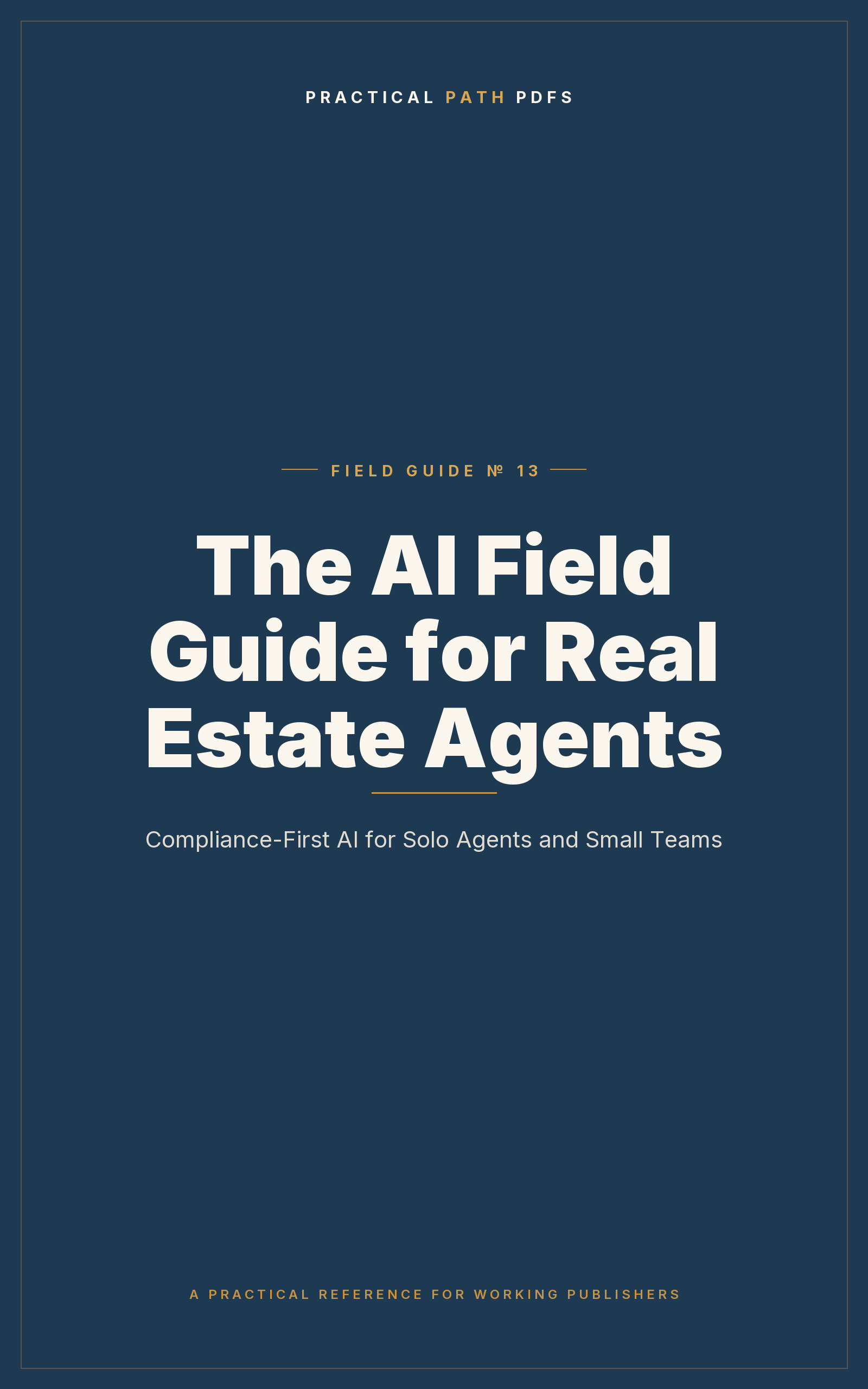
The AI Field Guide for Real Estate Agents, First Edition. Published by Practical Path PDFs.
Practical guides for solving today’s problems.